Love, Infringement: Apparel Makers Settle “Love, Hurts” and “Dear, Chuck” Trademark Dispute
Just do it, right? Well…not so fast. While modern apparel marketing moves at championship speed, trademark clearance does not. A simmering trademark dispute among major sports apparel makers and a small lifestyle brand over various “LOVE, ___” and “DEAR ___” designs, including Nike’s “Love, Hurts” marketing campaign, is a wrap after the parties reached a settlement in May 2026. (Converse Inc. v. Love, Kelly Holdings LLC, No. 25-09516 (S.D.N.Y. Stipulation of Dismissal May 20, 2026)). The litigation shows how modern sports branding can easily jump from the showroom to social media to federal court.
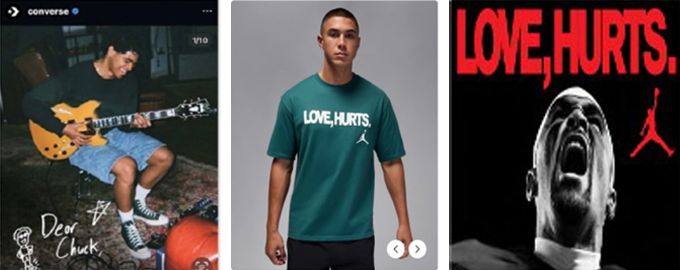
In February 2025, Nike launched the “Love, Hurts” campaign: a slogan that simultaneously referenced Super Bowl winning quarterback Jalen Hurts’ name, the city of Philadelphia’s identity (and “Brotherly Love” nickname), and the resilience narrative that had come to define the quarterback’s career. The campaign proved so successful that Nike also released a line of sports apparel around the concept. Around the same time, Converse rolled out its own campaign, “Dear Chuck” and “Love, Chuck” for its Converse All Star shoe, using the concept of a love letter with the shoe’s namesake Chuck Taylor being the sender or recipient. [See some images below of the marketing campaigns from the pleadings].
Following the campaign launches by Nike and Converse, Love, Kelly Holdings, LLC (“Love, Kelly”), a small fashion and multimedia company, publicly accused both companies on social media posts and videos of copying its branding. Love, Kelly has used the LOVE, KELLY and DEAR LOVE concepts in connection with its clothing designs and creative projects for several years and claimed common law trademark rights in these two concepts through what it described as “acquired considerable goodwill and distinctiveness” in the marks. [See below images from the pleadings showing the relevant Love, Kelly designs].

Love, Kelly had previously collaborated with Converse in 2024 for a fashion show and accused the company, along with Nike (which owns Converse), of using ideas shared during that relationship to develop their respective campaigns. Love, Kelly claimed that Nike’s “Love, Hurts” campaign and Converse’s “Dear Chuck” / “Love, Chuck” campaign appropriated the company’s preexisting LOVE, KELLY and DEAR LOVE marks in commerce and branding concepts. A letter from Love, Kelly’s attorneys followed suggesting potential legal action and a demand for compensation/royalties.
Rather than waiting to be sued, Nike and Converse took the offensive. On November 14, 2025, Nike and Converse filed suit in the Southern District of New York seeking a declaration that their campaigns did not infringe and that Love, Kelly lacked any common law trademark rights in the marks at issue. Nike and Converse maintained that the campaigns were independently created and that no Converse employees were involved in the creation of Nike’s “Love, Hurts” campaign.
Nike and Converse further stated that, regardless, Love, Kelly could not claim exclusive rights to common “DEAR ___” and “LOVE ___” formulations as the purported marks were not inherently distinctive due to the commonplace, open-ended nature of the words “Dear” and “Love.” They further argued that the concept underlying the campaigns, such as framing communications as letters or “love letters” to consumers, were common marketing devices rather than protectable intellectual property. To boot, Nike and Converse further claimed no evidence of actual consumer confusion since they launched the marketing campaigns in February 2025.
Love, Kelly did not merely defend against Nike’s and Converse’s declaratory judgement claims; instead, it went on the offensive, asserting counterclaims for common law trademark infringement and unfair competition under the Lanham Act, as well as false advertising and deceptive business practices under New York law. At their core, the counterclaims reflected Love, Kelly’s contention that Converse gained access to its branding concepts during the parties’ 2024 collaboration and subsequently incorporated those concepts into the “Love, Chuck” campaign, while Nike allegedly extended the same branding approach to its “Love, Hurts” campaign, all in the same channels of trade as Love, Kelly. Love, Kelly further alleged that the campaigns caused consumer confusion and improperly capitalized on the goodwill associated with its brand.
Unlike many trademark disputes, which involve federally registered marks, Love, Kelly’s federal trademark applications were still pending at the USPTO during this suit (and according to the plaintiffs’ complaint, the DEAR LOVE and LOVE, Kelly trademark applications were only filed about a month before Nike received a demand letter from Love, Kelly). Fast forward to the day before the settlement, on May, 19, 2026, the LOVE, KELLY mark was officially registered; the DEAR LOVE application remained pending.
Without a federal trademark registration covering the marks at the outset of the suit, the dispute centered largely on whether Love, Kelly had developed sufficient common law trademark rights, which is centered on its use of the phrases in commerce. With respect to its counterclaims, Love, Kelly lacked certain rights of federal trademark owners under the Lanham Act, including a presumption of validity and the ability to seek enhanced remedies.
The litigation appeared poised to enter a more substantive phase shortly before it ended. On May 15, 2026, Nike and Converse moved to dismiss portions of Love, Kelly’s counterclaims, arguing that several of the asserted state law causes of action, including deceptive business practices and false advertising, failed as a matter of law. However, before the motion to dismiss could be fully briefed and argued, the parties resolved the litigation on May 20, 2026, jointly dismissing all claims and counterclaims with prejudice.
The dispute highlights the increasingly important reality that athlete- and celebrity-centered marketing campaigns are not simply advertisements but valuable intellectual property assets for brands. For example, by combining the elements surrounding Hurts, his personal story, and the city of Philadelphia, Nike transformed a championship moment into a marketing asset capable of driving fan engagement and merchandise sales.
The case also underscores the increasing role social media plays in modern intellectual property disputes. Before litigation commenced, Love, Kelly publicly accused Nike and Converse of appropriating its ideas through a series of defiant social media posts, essentially pre-litigating the dispute in an attempt to reach fashion devotees to change public perception of the big brands’ reputation and portray its IP dispute as a David vs. Goliath scenario.
However, because the parties resolved their claims before any ruling on the merits, many of the underlying legal questions in this underdog matchup will remain unanswered.