KEY TAKEAWAYS
- Absent a consensual handover or light touch enforcement, administration or fixed charge receivership (FCR) may implement a negotiated creditor-led transaction or a unilateral enforcement. The optimal process depends on where value sits and how it can best be transferred or realised.
- Administration may be more appropriate where whole-company control, a statutory moratorium and stakeholder continuity are required to preserve going-concern value.
- FCR may provide a faster, more targeted route where value can be preserved through enforcement over shares in a key holding company or where value is concentrated in discrete charged assets such as real estate, intellectual property or receivables.
- Secured creditors should undertake significant due diligence, the scope of which will depend on their information rights, their relationship with management and management’s independence from any sponsor.
- Administration can take two forms: a trading administration, where the business continues operating while a sale or restructuring is pursued, and a pre-pack administration, where a sale is negotiated before appointment and completed shortly after.
- Where licensing or regulatory consents are required for a pre-pack, administrators can operate the business under transitional arrangements pending the relevant consent.
ADMINISTRATION AND FCR AT A GLANCE
Key: ✓ Yes | ✗ No | ◐ Qualified or subject to conditions
| Feature | Administration | FCR |
|---|---|---|
| Best suited to | Whole-business restructuring or sale where going-concern value and stakeholder continuity matter. | Realisation of discrete charged assets or enforcement of share security. |
| Automatic moratorium | ✓ A company-wide statutory moratorium restricts most creditor action. | ✗ No company-wide statutory moratorium arises from the appointment but often assets are sold immediately. |
| Company control by officeholder | ✓ Administrators control the company’s affairs, business and property (though they may authorise the directors to continue to exercise certain management powers if appropriate for the ongoing trading of the company). | ◐ The receiver controls only the charged asset, although enforcement over shares may confer indirect control over the underlying company or group. The board otherwise remains in control. |
| Court approval | ◐ A court order is not required for a valid out-of-court appointment, although administration may also be commenced by court order and certain asset sales may require court involvement. | ✗ A receiver is typically appointed under the security document without prior court approval. In practice, the appointment is generally arranged by the agent or security trustee, acting on the instructions of the required lenders under the applicable financing and intercreditor arrangements, who will instruct the proposed receiver and coordinate the appointment mechanics. |
| Creditor approval | ◐ No general creditor vote is required. A qualifying floating charge holder may appoint administrators where the statutory conditions are satisfied, and persons entitled to appoint an administrator or administrative receiver may consent to a company/director appointment before the statutory notice period expires. The company’s board may also file the appointment documents directly where the requisite notice has been given or consents obtained. | ✗ No general creditor vote is required. A secured creditor may appoint a receiver where its security gives it that right, subject to the relevant enforcement triggers, appointment formalities and any intercreditor controls. |
| Challenge period | N/A: No single statutory challenge period applies; the available route and timing depend on the appointment, decision or transaction challenged. | N/A: No single statutory challenge period applies; challenges depend on the security, appointment and exercise of the receiver’s powers. |
| Principal limitation | — Administrators act independently under statutory objectives within a more formal and costly process. | — The process is limited to the security and charged asset, and a subsequent administration may disrupt the enforcement strategy, although this is primarily a concern in a trading administration where the administrator requires the receiver to vacate office. |
INTRODUCTION
When a borrower group enters distress, the focus shifts to preserving value, minimising execution risk and maximising recoveries. Administration and FCR can deliver a negotiated restructuring or sale (transferring the business into a creditor-controlled or third-party structure) or serve as unilateral recovery tools when consensus fails. Enforcement does not mean the business will cease trading or be broken up.
The route depends on how value is best preserved, which can include a business and asset sale, a share transfer or realisation of specific charged assets. This requires a legal and financial review of the relevant transaction mechanics and supporting documents:
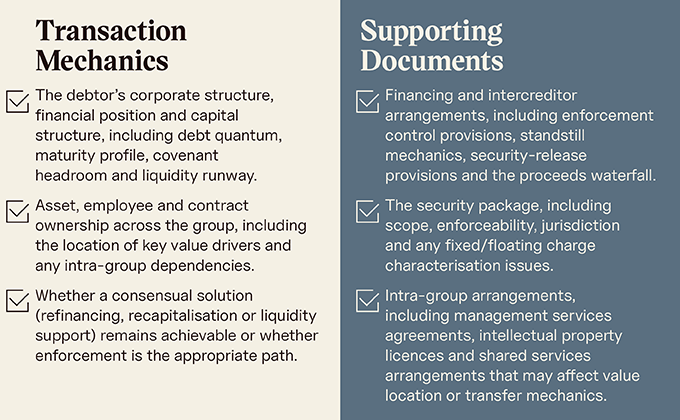
Where a deal is possible, the question is which route offers the cleanest execution and best preserves value.
ROUTE 1: ADMINISTRATION
Administration places a company under the control of licensed insolvency practitioners. Administrators must perform their functions with one of three statutory objectives:
- rescuing the company as a going concern;
- achieving a better result for creditors as a whole than would be likely in a winding-up without prior administration; or
- realising property in order to make a distribution to one or more secured or preferential creditors.
These objectives operate in a statutory hierarchy. Administrators must pursue a rescue unless it is not reasonably practicable or a better result would otherwise be achieved for creditors as a whole. The third objective is available only where neither of the first two objectives is reasonably practicable and pursuing it would not unnecessarily harm creditors as a whole.
Administrators may be appointed by court order or out-of-court by either the holder of a qualifying floating charge (broadly, a floating charge that contains the required appointment wording and, alone or together with other security, relates to the whole or substantially the whole of the company’s property), or by the company or its directors. Once appointed, they manage the company’s affairs, business and property and have broad statutory powers to take the steps necessary or expedient for that purpose. The directors cease to exercise executive authority save to the extent approved by the administrators but remain in place.
A statutory moratorium also restricts most security enforcement, repossession and legal proceedings without the administrators’ consent or the court’s permission. The administrators act as agents of the company and must perform their functions in accordance with the applicable statutory objective in the interests of the company’s creditors as a whole. The moratorium does not extinguish the rights of fixed charge holders, who retain their security interests and priority, but enforcement is stayed unless the administrators consent or the court grants permission. Certain essential suppliers, such as electricity and gas suppliers, are protected by statutory restrictions that prevent them from making continued supply conditional on payment of pre-administration debts, although many other creditors, including trade suppliers, landlords and commercial counterparties, are not similarly protected and may seek to terminate or restrict supply.
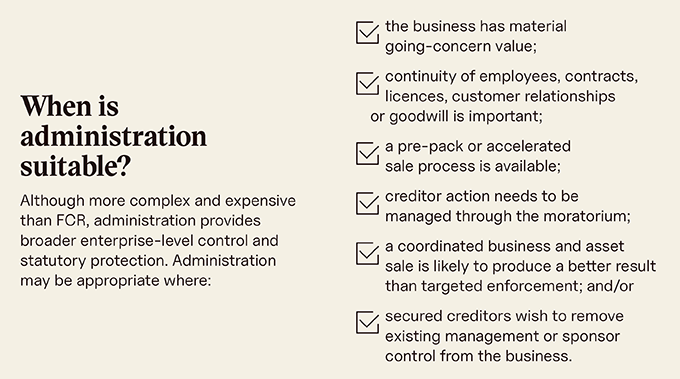
As noted above, administration can take the form of a pre-pack (where the sale is negotiated before appointment and completed immediately or shortly after) or a trading administration (where the business continues to trade under the administrators’ control while a sale or restructuring is pursued).
Administrators may continue trading, retain employees and seek continued performance from suppliers, landlords, customers and other essential counterparties where necessary to preserve enterprise value. Care should be taken, however, to identify any contracts that contain insolvency-related termination rights (i.e., ipso facto clauses), which may allow counterparties to terminate on the company’s entry into administration. While certain essential supply contracts are protected by statutory restrictions on termination, many commercial contracts remain terminable, and early engagement with critical counterparties may be necessary to secure continued performance.
Secured creditors must therefore assess which stakeholders are critical, the funding required to maintain the business through the sale process and whether the expected uplift in recoveries justifies the cost and risk of trading in administration.
Where a distressed sale has been negotiated before appointment, often with the involvement of the proposed administrators who will have been engaged to advise on valuation and transaction structure, a pre-pack places the final decision to complete the transaction with the administrators. This may reduce execution risk for directors compared with completing the distressed sale themselves, particularly where the administrators have independently assessed the valuation, marketing and proposed outcome. It does not, however, provide a safe harbour or release the directors from their pre-appointment duties, and their conduct remains subject to review post-administration.
In practice, most administrations are commenced out of court, either by a qualifying floating charge holder or by the company or its directors. A court application may nevertheless be appropriate where the appointment is contested, where the company is subject to existing proceedings that require coordination, or where an urgent order is needed to provide clarity or injunctive relief. A court application may also be the preferred route for a qualifying floating charge holder where its entitlement to appoint is disputed, for example where the validity of the security or the existence of an enforcement event is challenged, as it enables the court to determine those issues and authorise the appointment in a single process. Out-of-court appointments are generally faster and less costly but require strict compliance with statutory formalities, including the filing of prescribed documents at court. The choice of appointment route should therefore be informed by timing, stakeholder dynamics and any legal or procedural complexity that may arise.
Pre-packs and value preservation
Most pre-packs are structured as business and asset sales, rather than sales of shares in the insolvent company. This allows the purchaser to acquire an agreed perimeter of assets and assume specified liabilities, while other liabilities generally remain with the seller, subject to those transferring by law or assumed as a commercial matter. This structure can preserve intangible value, including brand, goodwill and customer relationships, while supporting continuity for employees, customers and critical services.
The proposed sale perimeter nevertheless requires careful analysis. The Transfer of Undertakings (Protection of Employment) Regulations 2006 (TUPE)[1] may apply to transferring employees, automatically transferring them to the purchaser on their existing terms with continuity of employment preserved; contracts and licences may need to be assigned or novated, potentially with third-party consent; and relevant change-of-control, insolvency and termination provisions should be reviewed. In addition, environmental obligations can pass to new owners or operators of a business, particularly where the purchaser acquires contaminated land or assumes responsibility for regulated activities. Transitional services arrangements are often required to support the purchaser’s operations during the period following completion, particularly where certain functions or systems remain with the seller or a related entity or where licences, permits or approvals are required from a regulatory or tax authority in order to operate part or all of the business.
Where assets are subject to fixed security, a sale free of that security will ordinarily require the secured creditor’s release or a court order under paragraph 71 of Schedule B1 to the Insolvency Act 1986. Any release or court application, together with the treatment of sale proceeds, should therefore be addressed as part of the transaction mechanics.
A pre-pack sale is negotiated with the prospective purchaser (and, where necessary, stakeholders whose continued support is critical to the business) before the administrators are appointed, with completion taking place immediately or shortly after their appointment. This process (and the speed with which it is carried out) can reduce trading costs and limit the risk of value erosion during a prolonged insolvency process. It must, however, be balanced against the need for appropriate valuation, marketing and scrutiny of the proposed transaction. In many cases, a competitive sales process is conducted prior to appointment, with multiple bidders given the opportunity to participate. This distinguishes the pre-pack from a trading administration, where the marketing and sales process takes place after appointment under the administrators’ control.
Statement of Insolvency Practice 16 (SIP 16) and connected party safeguards
A sale by administrators takes place within a recognised statutory process, although purchasers usually receive limited warranties and recourse, given its implementation in a formal insolvency procedure. SIP 16[2] requires creditors to receive sufficient information to understand the circumstances surrounding a pre-pack and why the administrators considered that course appropriate. This includes details of marketing, valuations, consideration and the purchaser’s identity.
Additional safeguards apply where, within the first eight weeks of administration, the administrators propose to make a disposal to a connected person of all or a substantial part of the company’s business or assets. Broadly, the administrators cannot complete the transaction unless creditor approval has been obtained or the connected purchaser has obtained a qualifying report from an independent evaluator. The report does not itself approve the transaction. If it concludes that the consideration and grounds for the disposal are not reasonable, the administrators may nevertheless proceed but must explain their reasons.
Investigations and recoveries
Administration also provides investigative and recovery tools that can maximise realisations. This is particularly useful where a secured creditor expects a shortfall and may therefore rank as an unsecured creditor for the balance of its claim not discharged by realisations from the secured assets. Administrators can use statutory powers under the Insolvency Act 1986 to obtain information, require cooperation and recover company property.[3] They may also investigate and, where appropriate, pursue antecedent transactions or director-conduct claims, including transactions at an undervalue, preferences, fraudulent trading and wrongful trading.
Any successful recoveries may increase the asset pool available for distribution and improve the overall outcome for creditors.
ROUTE 2: FIXED CHARGE RECEIVERSHIP (FCR)
FCR enables a secured creditor to appoint a receiver over a charged asset pursuant to the terms of the security document, typically without court involvement. Where the charged asset is shares in a key holding company, FCR can provide a single point of enforcement through which ownership of the relevant entity or group is transferred. This may be an attractive route for lenders seeking to enforce against leveraged structures, as it can deliver control without the need to address the wider business or underlying operating assets directly. FCR may also be used to realise discrete charged assets, such as real estate, although this is generally a secondary consideration in most leveraged finance contexts.
The receiver is typically a licenced insolvency practitioner and will usually act as agent of the chargor (and not the appointing creditor), although the precise agency position and the scope of the receiver’s powers will depend on the security document and applicable law. The commercial purpose of the appointment is generally to preserve and realise the charged asset and apply the proceeds in accordance with the security arrangements.
When is FCR suitable?
Receivership is generally faster, narrower in scope and less costly than administration. It is most commonly considered where the enforcement strategy is focused on taking control of and realising a specific charged asset, particularly where that asset delivers control of the underlying business (for example, shares in a holding company that owns the operating group) or can be realised without the need for control of the wider business. It may be especially attractive where the charged asset is expected to discharge the secured debt in full, but can also be appropriate where targeted enforcement offers the clearest route to maximising recoveries, even if a shortfall remains.
Where security includes shares in a key holding company, a receiver may be able to sell those shares (including by way of pre-pack sale) to a third party or a creditor-controlled acquisition vehicle. This can provide a single point of enforcement through which ownership of the relevant company or group is transferred while the underlying assets, employees, contracts and licences remain within the same legal entities. A share receivership may therefore avoid some of the transfer and consent issues associated with a pre-pack business and asset sale.
A share sale does not, however, separate the sold business from its historical liabilities. The purchaser acquires the relevant company with its existing assets and liabilities, and the transaction may trigger change-of-control provisions in financing arrangements, material contracts, licences or regulatory approvals. Appropriate diligence and stakeholder engagement will therefore remain important.
Although the receiver’s commercial mandate is generally to preserve and realise the charged asset for the benefit of the appointing creditor, the receiver should, in exercising a power of sale, take reasonable care to obtain the best price reasonably obtainable for the asset in the circumstances. This applies in addition to any valuation requirements or other enforcement requirements applicable in the relevant finance documents. Appropriate valuation advice and a properly considered marketing strategy will therefore generally be important, although the required process will depend on the nature of the asset and the circumstances of the enforcement.
To support these objectives, well drafted security documentation will give wide-ranging powers to the receiver which, subject to the drafting, will typically extend beyond a straightforward sale and may include:
- continuing operations associated with the charged asset;
- granting leases or undertaking development works in the case of real estate assets; or
- initiating legal proceedings in respect of the asset.
These powers may allow the receiver to preserve or enhance the value of the charged asset before sale. The narrower scope of FCR means that secured creditors should identify any operational dependencies affecting the charged asset before appointment. The value of real estate, shares or another charged asset may depend on employees, licences, contracts, IT systems or services provided by the wider company or group. Cooperation, interim funding or transitional arrangements may therefore be required.
Where those dependencies cannot be maintained within the receiver’s powers, administration may offer the more effective route despite its additional cost and complexity.
Limitations and execution risks
While FCR can be an effective and efficient enforcement tool, it is not without limitations. The receiver’s powers and the available recoveries are limited by the scope of the security and the appointment. The appointment may also be challenged if the underlying default, the enforceability of the security (including whether a purported fixed charge is properly characterised as floating in nature), the creditor’s right to appoint or the appointment formalities are disputed. Similar challenges may arise in administration, particularly in leveraged finance structures where the validity or scope of the security package may be contested. In a real estate enforcement, additional disputes may arise in relation to possession, occupational interests or the proposed sale strategy. Any challenge can delay enforcement and increase costs.
In the context of a prolonged receivership (rather than a pre-pack), secured creditors should also assess the likelihood that the company will subsequently enter administration or liquidation. Where a company enters administration, an administrator may require a receiver of part of the company’s property to vacate office, subject to exceptions including where the receiver was appointed under a charge created or arising under a financial collateral arrangement.[4] This may interrupt the enforcement strategy, duplicate costs and delay realisations. The potential interaction between FCR and any wider insolvency process should therefore be considered before appointment, particularly where share security is being enforced.
Where value depends on preserving the business as a whole, administration may be more appropriate unless share security provides a viable route to transfer the relevant company or group.
CONCLUSION
In a higher interest rate environment with refinancing pressure across leveraged capital structures, these enforcement tools are increasingly relevant. The choice between administration and FCR turns on the terms of the financing documents, the security structure, where value sits, the transaction required to preserve it and whether the process implements a negotiated deal or pursues unilateral recoveries. A pre-pack may preserve the business through a sale of selected assets, leaving residual liabilities in the insolvent seller. A share receivership may instead transfer ownership with assets and liabilities remaining in place.
Secured creditors should act early: identify where value sits and how it can be transferred, validate security and appointment mechanics, map operational and stakeholder dependencies and test intercreditor controls and competing insolvency risk. Early preparation preserves optionality, reduces execution risk and gives creditors the best chance of protecting value before it deteriorates.
_______________
[1] The Transfer of Undertakings (Protection of Employment) Regulations 2006 (TUPE) protect employees when the business or undertaking for which they work transfers to a new employer. Where TUPE applies, employees automatically transfer to the purchaser on their existing terms and conditions, with continuity of employment preserved. TUPE also imposes information and consultation obligations and restricts dismissals connected to the transfer unless an economic, technical or organisational reason applies.
[2] SIP 16 sets out required practice for pre-packaged sales in administrations.
[3] Sections 234 to 237 of the Insolvency Act 1986.
[4] Regulation 8(2) of the Financial Collateral Arrangements (No. 2) Regulations 2003.