INTRODUCTION
Governance changes prior to, or as part of, a restructuring may involve appointing a single additional director, appointing a director with enhanced powers under agreed governance arrangements, or reconstituting the board more broadly. The appropriate scope depends on the company’s circumstances and the powers needed to make the change effective. A board change can deliver a governance reset, either as an objective in itself or as a light-touch form of enforcement. Typically, it is implemented through enforceable share-security rights or by agreement with the relevant shareholders and existing directors.
INFLUENCE IS NOT MANAGEMENT
Lenders must distinguish the exercise of creditor or shareholder rights from management of the company. A lender or security agent may enforce security, exercise shareholder voting rights (pursuant to security rights), propose a restructuring or decide whether to provide funding. The board, however, must independently decide whether the company should accept a proposal.
Communications with incoming directors should reflect that division. Lenders should present proposals on their merits, avoid directive or informal instructions and assume that communications may later be reviewed in litigation or an insolvency process. Company counsel should advise the board separately from lender counsel. An incoming director may also require personal advice in a contested situation.
These safeguards help limit the risk of a lender being treated as a shadow or de facto director. Someone may be a shadow director if the board routinely follows their instructions, whatever their formal title. A person who acts as a director without formal appointment may be treated as a de facto director, with the same fiduciary duties and potential liability for breach as an appointed director. Shadow directors may also owe directors’ duties, to the extent those duties apply to their role.[1] Independent advice, genuine board deliberation and a clear record separating lender and company decisions matter more than an “independent” label.
BOARD CHANGE AT A GLANCE
A possible route for a potentially viable business that needs stronger governance or an independent review of its options.
| Question | Answer | Key Considerations |
|---|---|---|
| How is it implemented? | By agreement or through available share-security rights | Establish the power, trigger and valid corporate steps; the consensual and enforcement routes are distinct |
| Does it start formal insolvency? | Not by itself, although often the share-security rights are only available after an acceleration. | The board change is most often unrelated to an insolvency process; any separate process needs its own analysis |
| Does it stop creditor action? | No moratorium arises from the board change | Other creditors may act unless a standstill, forbearance or separate statutory process applies |
| Does ownership change? | The appointment alone transfers neither shares nor assets | Consider the share security and any accompanying or later enforcement separately; regulatory control or reporting requirements may be relevant even without a transfer of ownership |
| Who runs the company? | The reconstituted board, subject to its duties and the constitution | A holding-company board change does not automatically replace subsidiary boards or day-to-day management. Parallel changes at operating-company level are commonly considered and may be helpful |
| Does it fix the finances? | It neither provides liquidity nor compromises liabilities of itself; however, an injection of liquidity may come on condition that a board change is effected | A funded plan and further restructuring or formal enforcement may still be needed |
WHEN DOES A BOARD CHANGE HELP?
A board change may suit a potentially viable business where governance is holding back the response to distress. For example, board deadlock may prevent agreement on a funded plan. Existing directors may lack restructuring experience or be overly concerned with the wishes and interests of existing shareholders.
An independent chair or additional directors can approach the situation with fresh eyes and relevant experience, commission an independent business review, test liquidity and viability, engage key stakeholders and potentially find exit options (whether for creditors or shareholders).
The company needs enough liquidity to support that work. A board change will not suit every situation. Administration may be preferable where a moratorium or officeholder’s powers are needed. Receivership may be appropriate to transfer charged shares or realize assets subject to fixed charge security. A board change may also prove unworkable if key contracts, licenses or banking arrangements become unavailable.
Preparing the enforcement route alongside consensual talks can keep alternatives open if those talks fail. That preparation should also take account of cost and the potential effect on stakeholder relationships.
HOW CAN THE BOARD BE CHANGED?
Consensual governance reset
A governance change may be agreed as a condition to a waiver, covenant reset, forbearance or new-money facility.
The lender may nominate one or more independent directors for appointment. The company must then follow its articles, which may permit appointment by a board decision or an ordinary resolution of members. Subject to the articles and the Companies Act 2006, a private company may be able to pass an appointment resolution in writing.
The parties may also amend the articles and any shareholders’ agreement to address board composition, quorum, committees or approval of material decisions. Enhanced rights may apply immediately or on agreed triggers, such as a covenant breach or missed restructuring milestone.
The agreed arrangements must neither require directors to follow lender instructions nor prevent them from taking action required in the company’s interests.
A board observer may be appointed to provide access to information where voting authority is unnecessary. An observer does not become a director merely by attending meetings, but the role must remain within its agreed limits. An observer who participates in management as if appointed to the board may create de facto director risk.
Enforcement of share security
Being a creditor does not itself give a lender the right to appoint directors. Share security may allow the security agent to exercise voting rights over charged shares after a specified trigger, often through a proxy or power of attorney. Those rights must support valid corporate action under the company’s articles. The route must also comply with the security and intercreditor arrangements, including any definition of “Enforcement Action” or equivalent term.
A majority-lender instruction does not itself confer shareholder voting authority. The parties must identify the registered holder of the relevant shares and confirm that the share charge, proxy or power of attorney validly enables the relevant person to exercise that holder’s rights. Note also that such further action may trigger additional problems for the borrower entity (such as regulatory issues relating to change of control processes). The harm of such actions will need to be weighed against the benefit of any proposed board change.
The trigger is document-specific: an Event of Default may suffice, but often a further action such as acceleration, a declared default or an enforcement notice may be required. Do not assume that a facility default automatically activates corporate rights.
The group structure also matters. Reconstituting the board of a top or intermediate holding company does not by itself replace the directors of an operating subsidiary. The new holding-company board may be able to exercise shareholder rights to change subsidiary boards, but each step must comply with the relevant entity’s articles, shareholders’ agreement and applicable local law. Each board must also consider the interests of its own company rather than treating the group as a single legal entity.
APPOINTMENT AND REMOVAL: THE CORPORATE MECHANICS
Appointing additional directors: when more seats change the outcome
Where the articles permit additional appointments without an effective cap, the security agent may be able to use share voting rights under the relevant security agreements to appoint enough directors for a board majority. This is often called “board flooding”. Because existing directors need not first be removed, it may be more efficient than the section 168 procedure under the Companies Act 2006 (“CA 2006”) discussed below.
Appointing additional directors does not necessarily deliver effective control. An existing director may still be needed for quorum or hold approval rights over material decisions. The pre-board change checklist below addresses these constitutional and contractual restrictions.
Retaining existing directors in office may preserve management knowledge and continuity. Depending on the circumstances, however, it may create deadlock, confidentiality concerns or competing instructions. Lenders should decide whether flooding, negotiated resignations or subsequent statutory removal best supports the company’s operation.
Removal under section 168 CA 2006
Section 168 CA 2006 permits a company to remove a director by ordinary resolution at a meeting, notwithstanding an agreement between the company and that director. The resolution cannot be passed as a written resolution. Special notice of the intention to move it must generally reach the company at least 28 days before the meeting. The company must notify members in accordance with section 312 CA 2006, and the director has the right to receive notice, make written representations and be heard at the meeting.[2]
Special notice is also required for a resolution at the same meeting to appoint a replacement for the director removed. The section 168 procedure may be required where the articles prevent further appointments or an existing director’s continued presence would obstruct the new board. Check the articles for weighted voting rights or reserved matters that may prevent the ordinary resolution from passing. Removal from the statutory office does not automatically terminate a separate employment or service agreement, and the outgoing director may retain a claim for compensation or damages.
BEFORE THE BOARD CHANGES
A coordinated legal, financial and operational review should answer three questions before implementation.
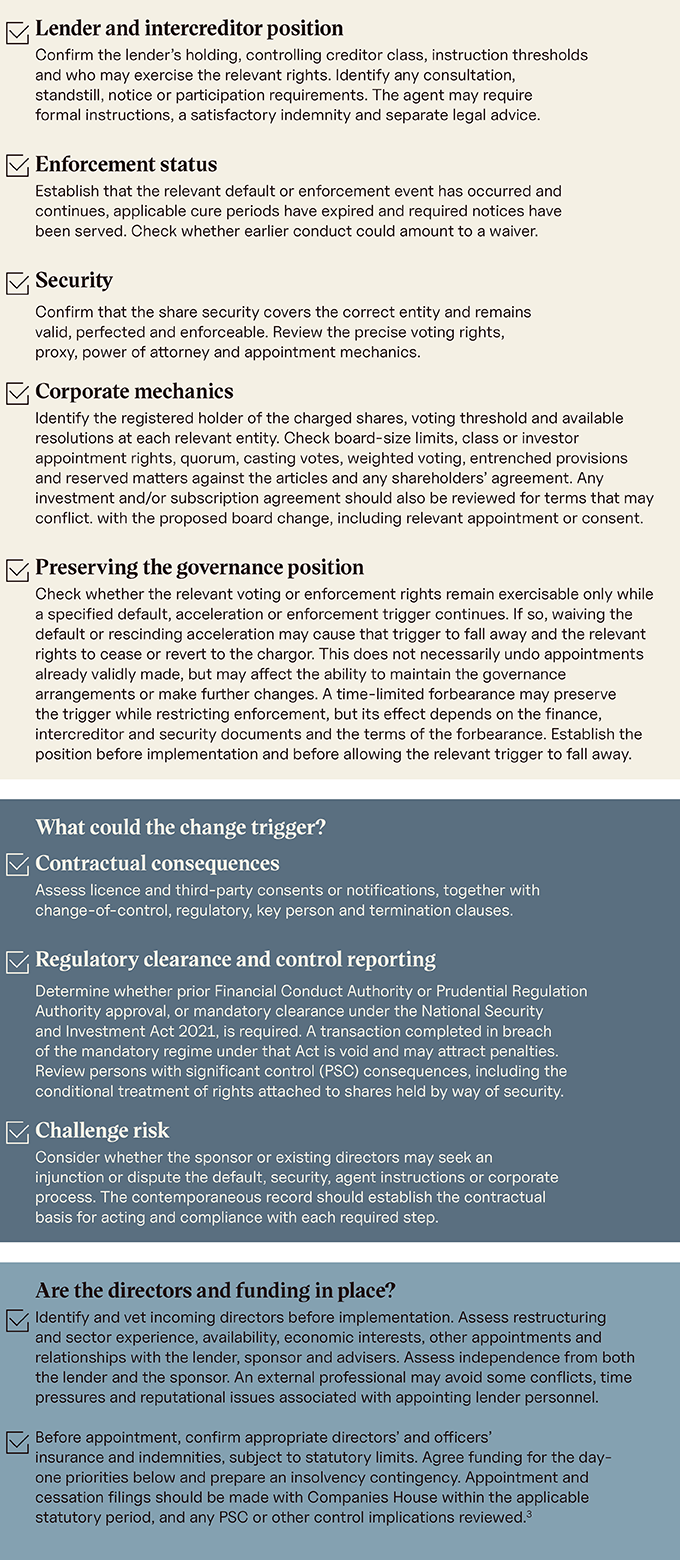
[3] Since 18 November 2025, companies are no longer required to maintain local registers of directors, directors’ residential addresses, secretaries or persons with significant control, but must continue to maintain their register of members.
THE INCOMING BOARD AND DIRECTORS’ DUTIES
“Independent director” is not a separate category of legal office under English company law. Each incoming director owes the same statutory and fiduciary duties to the company as any other director. These include duties to act within powers and for proper purposes, promote the success of the company, exercise independent judgment, exercise reasonable care, skill and diligence and manage conflicts of interest.[4]
As financial difficulties deepen, the board must assess whose interests it is required to consider under section 172. In BTI 2014 LLC v Sequana SA, the Supreme Court confirmed that the duty remains owed to the company but, in certain circumstances, the company’s interests include those of its creditors as a whole. The rule may be engaged where the company is insolvent or bordering on insolvency, or where insolvent liquidation or administration is probable. Its precise onset is fact-sensitive, and the judgments took differing approaches to whether directors must know or ought to know of those circumstances. A real and not remote risk of future insolvency is insufficient. Once the creditor-interest rule is engaged, the weight given to creditors’ interests increases as the company’s financial difficulties become more serious. Where insolvent liquidation or administration is inevitable, shareholders’ interests cease to carry weight.[5]
Disagreement belongs in the boardroom, not in a parallel strategy. In the 2026 decision of Saxon Woods Investments Limited v Costa, the Supreme Court reinforced the collective nature of board management. The case concerned a sale process delegated to one director. The Supreme Court held that the director could not use that delegation to pursue covertly a strategy conflicting with the board’s own. A director who disagrees must bring their view to colleagues and participate openly in the constitutional decision-making process. The good-faith requirement in section 172 CA 2006 applies to conduct as well as the director’s thought process.[6]
Directors must also monitor insolvency-law risks. Wrongful trading exposure may arise if a director knew or ought to have concluded that there was no reasonable prospect of avoiding insolvent liquidation or administration and failed to take every step that ought to have been taken to minimize potential loss to creditors.[7] Further borrowing, transactions with connected parties and payments to selected creditors require particular care. Resignation does not remove liability for earlier conduct; whether a director should remain in office depends on their continuing ability to obtain information and discharge their duties.
DAY ONE: PRACTICAL PRIORITIES
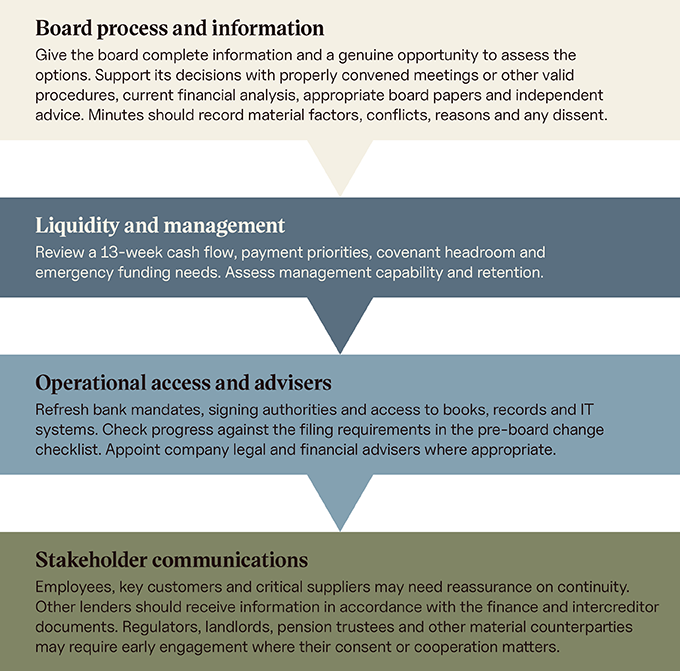
THE NEXT DECISION
Once the immediate position is stable, the board can assess new money, an amend-and-extend transaction, a debt-for-equity swap or another consensual recapitalization. A solvent sale may be possible if liquidity allows. A scheme of arrangement, restructuring plan or company voluntary arrangement may help address creditor dissent, provided the applicable voting thresholds and other statutory requirements are met. If the company has insufficient liquidity to pursue these options, administration, receivership or liquidation may still be required.
CONCLUSION
Changing the board is a starting point, not a rescue plan. Its value depends on what the new board can do next, with the funding, information, independence and breathing room to make those decisions.
_______________
[1] Companies Act 2006, sections 170–178, 250 and 251. Section 250 includes any person occupying the position of director, by whatever name called. Under section 170(5), the general duties apply to shadow directors where and to the extent that they are capable of applying. Section 178 addresses the civil consequences of breach.
[2] Companies Act 2006, sections 168 (removal by ordinary resolution), 169 (the director’s right to protest), 288(2)(a) (a written resolution cannot be used) and 312 (special notice). Special notice should be given to the company at least 28 days before the meeting. However, under section 312(4), if the company then calls the meeting for a date 28 days or less after receiving that notice, the notice is still treated as properly given. This prevents the board from defeating the resolution by calling the meeting early. Note that the articles may give a director weighted votes on a resolution to remove them, which can block removal in practice: see Bushell v Faith [1970] AC 1099.
[3] Since 18 November 2025, companies are no longer required to maintain local registers of directors, directors’ residential addresses, secretaries or persons with significant control, but must continue to maintain their register of members.
[4] Companies Act 2006, sections 170 to 177. Section 170(1) confirms that the general duties are owed to the company. Under section 173(2), the duty to exercise independent judgment is not infringed by acting in accordance with an agreement duly entered into by the company that restricts the future exercise of discretion, or in a way authorized by the company’s constitution. This does not disapply the director’s other duties.
[5] BTI 2014 LLC v Sequana SA and others [2022] UKSC 25. The Supreme Court confirmed the existence of the common law rule preserved by section 172(3), but rejected a real and not remote risk of insolvency as the trigger. The judgments used formulations including insolvency or bordering on insolvency and the probability of an insolvent liquidation or administration. Where insolvent liquidation or administration is inevitable, the interests of members cease to bear weight.
[6] Saxon Woods Investments Limited and others v Costa [2026] UKSC 21. The Supreme Court held that good faith under section 172 applies to a director’s conduct as well as the formation of their business judgment. An individual director may not use delegated authority to pursue covertly a dissenting strategy that subverts the board’s constitutional responsibility for management.
[7] Insolvency Act 1986, sections 214 and 246ZB.